Golden Temple in Amritsar: History, Architecture and Cultural Significance
From Guru Ram Das Ji's sarovar to Maharaja Ranjit Singh's gilding and the trauma of 1984, the Golden Temple's history is the history of the Sikh community. This article traces its story and reads its architecture.
Published Updated 7 min read
In this article
- Beginnings: the pool and the city
- Guru Arjan Dev Ji builds the Harmandir
- The Akal Takht and a changing century
- The eighteenth century: destruction and devotion
- Maharaja Ranjit Singh and the "Golden" temple
- Colonial management and the Gurdwara Reform Movement
- 1984 and its aftermath
- Harmandir Sahib today
- Reading the architecture
- Cultural significance
The Golden Temple is one of the most recognisable buildings in the world. Its gilded upper storeys, mirrored in still water, appear on postcards, in documentaries and in countless photographs. But Sri Harmandir Sahib in Amritsar is not a monument frozen in time. It has been founded, destroyed, rebuilt, embellished, contested and restored, and through every stage it has remained the spiritual heart of the Sikh community.
This article traces that history and then looks closely at the architecture that makes the shrine so distinctive.
Beginnings: the pool and the city
The story begins with water. In the 1570s, Guru Ram Das Ji, the fourth Sikh Guru, began excavating a pool at a site in the Majha region of Punjab. A settlement grew around it, known as Ramdaspur or Guru ka Chakk. The Guru encouraged traders and craftsmen to settle, and the town quickly became a centre of commerce as well as devotion. The pool became known as Amritsar, "the pool of nectar", and in time the whole city took its name.
Tradition credits the idea of a central gathering place to Guru Amar Das Ji, the third Guru, and remembers Baba Buddha Ji as overseeing the excavation from beneath a ber tree that still stands in the complex.
Guru Arjan Dev Ji builds the Harmandir
Guru Arjan Dev Ji, the fifth Guru, completed the sarovar and built a shrine in its midst. A widely held tradition says the foundation stone was laid around 1588–89 by Mian Mir, a Sufi saint of Lahore, at the Guru's invitation, although some historians argue the Guru laid it himself.
Several features of the design carried deliberate meaning:
- It was built on a lower level than the surrounding land, so that worshippers step down to enter. This is traditionally explained as a lesson in humility.
- It had entrances on all four sides, in contrast to shrines with a single door, signalling that people of every direction, caste and creed were welcome.
- It stood in the middle of the water, reached by a causeway, a place of calm set apart from the bustle of the town.
In 1604, Guru Arjan Dev Ji installed the newly compiled Adi Granth, the scripture containing the hymns of the Gurus and of saints from different backgrounds, in the Harmandir. Baba Buddha Ji was appointed its first granthi. From that moment the shrine became the home of the scripture that Sikhs would later honour as Sri Guru Granth Sahib Ji.
The Akal Takht and a changing century
In 1606, soon after Guru Arjan Dev Ji's martyrdom in Lahore, his son Guru Hargobind Ji built a raised platform facing the Harmandir. It became known as the Akal Takht, "the throne of the Timeless", and represented the temporal dimension of Sikh life alongside the spiritual authority of the Harmandir. Today Sri Akal Takht Sahib is the highest of the five Takhts, the seats of Sikh authority.
Later in the seventeenth century the Gurus moved their base away from Amritsar, to Kiratpur and then Anandpur. For long periods the Harmandir was controlled by rival claimants to the Guru's succession, and its management passed through several hands. In the closing years of the century, Guru Gobind Singh Ji entrusted its care to Bhai Mani Singh, the scholar who later became one of the great martyrs of the eighteenth century.
The eighteenth century: destruction and devotion
The eighteenth century was the most turbulent in the shrine's history. As the Sikhs struggled against Mughal governors and Afghan invaders, Harmandir Sahib became both a symbol and a target.
- Bhai Mani Singh was executed in Lahore in the 1730s. Accounts connect his death with a dispute over a gathering at Amritsar at Diwali.
- In 1740 the shrine was desecrated by a local official, Massa Ranghar, who was killed in retribution by two Sikhs, Mehtab Singh and Sukha Singh.
- The Afghan ruler Ahmad Shah Abdali attacked Amritsar repeatedly. The shrine was badly damaged in 1757, and the elderly warrior-scholar Baba Deep Singh died fighting to reach it that year. In 1762 Abdali's forces blew up the building and filled the sarovar, and there was further destruction in 1764.
Throughout, Sikhs returned to Amritsar whenever they could, especially at Vaisakhi and Diwali, when the Sarbat Khalsa, the assembly of the whole community, met to take collective decisions. From the mid-1760s, the Sikh misls (confederacies) began rebuilding the shrine. Much of the structure we see today dates from this reconstruction.
Maharaja Ranjit Singh and the "Golden" temple
In the early nineteenth century Maharaja Ranjit Singh, who united Punjab into a Sikh kingdom, became the shrine's great patron. Under his sponsorship the upper storeys were covered in gilded copper plates, and the lower walls were faced with white marble decorated with inlaid designs. Craftsmen from across the region, including artisans skilled in Mughal-era techniques, worked on the embellishment. It is from this period that the English name Golden Temple comes.
Many other Sikh nobles and families also contributed, and the buildings around the parikrama grew during this period.
Colonial management and the Gurdwara Reform Movement
After the British annexed Punjab in 1849, the shrine came under a manager appointed with government approval, and day-to-day control lay with hereditary custodians. By the early twentieth century, many Sikhs objected to practices at the shrine and to government influence over it.
The Gurdwara Reform Movement of the 1920s sought to bring historic gurdwaras under elected Sikh management. It included the "keys affair" of 1921–22, when Sikhs campaigned successfully for the return of the treasury keys of Harmandir Sahib that the authorities had taken. The Shiromani Gurdwara Parbandhak Committee (SGPC) was formed in 1920, and the Sikh Gurdwaras Act of 1925 placed Harmandir Sahib and other historic gurdwaras in Punjab under its control. The SGPC's headquarters are within the complex today.
1984 and its aftermath
In June 1984 the Indian Army carried out Operation Blue Star, a military operation to remove armed militants led by Jarnail Singh Bhindranwale who had taken positions inside the complex. The operation, which coincided with the anniversary of Guru Arjan Dev Ji's martyrdom when many pilgrims were present, caused many deaths, including of civilians. Sri Akal Takht Sahib was heavily damaged, and the Sikh Reference Library, with its manuscripts and historical documents, was destroyed by fire.
The events of 1984 caused deep and lasting pain in the Sikh community and remain a subject of remembrance each June. The Akal Takht was later rebuilt through kar seva by the Sikh community. Further security operations took place at the complex in 1988.
Harmandir Sahib today
Today the complex receives very large numbers of visitors every day, from Sikh pilgrims to tourists of every faith, with the numbers rising sharply on Gurpurabs, Vaisakhi and Bandi Chhor Divas. Its community kitchen, the Guru Ram Das Langar, is often described as one of the largest free kitchens in the world. It serves tens of thousands of people daily, and far more on festival days, with much of the work done by volunteers.
The surroundings have also changed. The sarovar has been cleaned and desilted through major kar seva efforts, and a redeveloped pedestrian approach, often called Heritage Street, now leads from the city to the complex.
Reading the architecture
The architecture of Harmandir Sahib is often described as a synthesis. It draws on the Indo-Islamic building traditions of the Mughal period and on the decorative traditions of north Indian and hill-state architecture, and brings them together into something distinctly Sikh.
The setting
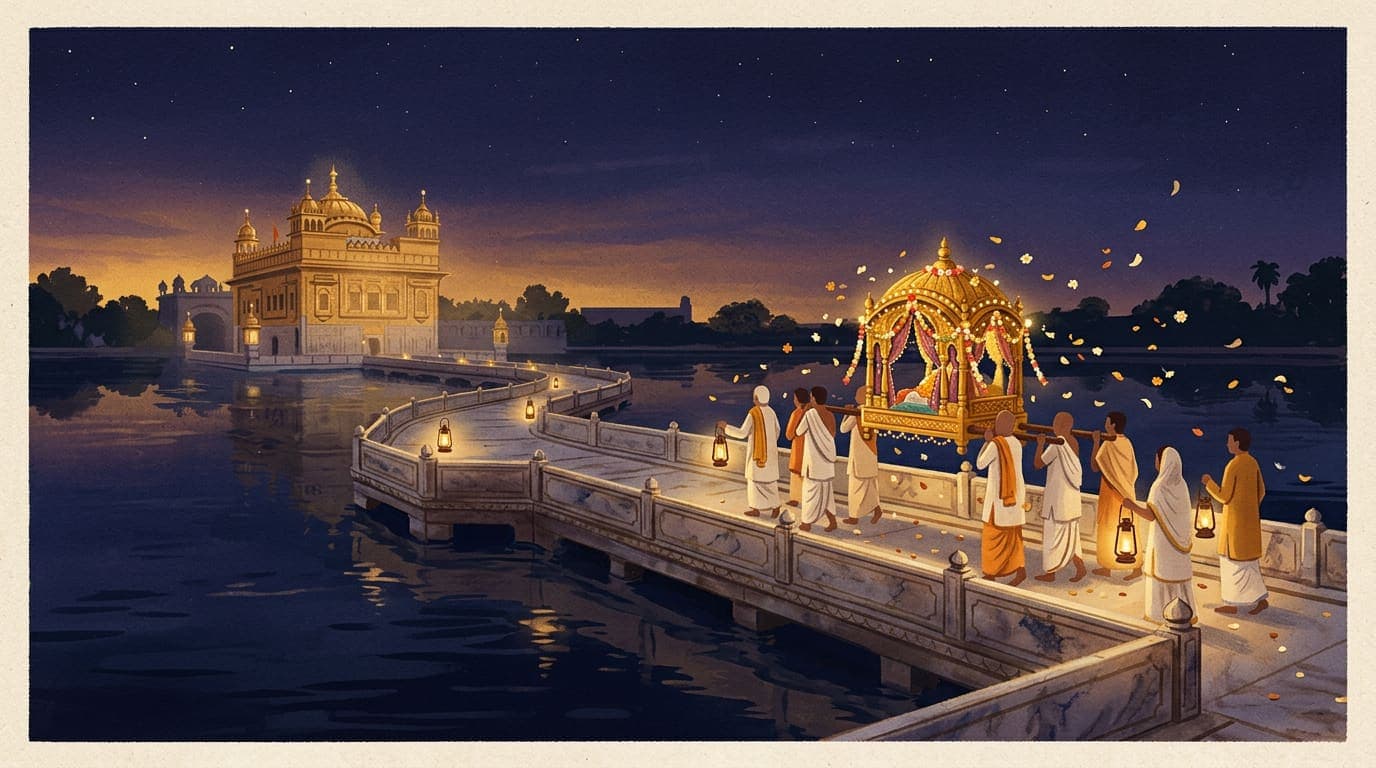
The shrine stands on a square platform in the middle of the square sarovar, reached by a causeway from the Darshani Deori, the ornate gateway on the western side. The whole composition is organised around water, reflection and the act of approach: you pass through the gateway, walk across the water and step down into the sanctum.
The sanctum
The main building has a square plan and rises through several levels. The ground floor, where Sri Guru Granth Sahib Ji is installed, is faced in white marble. The upper storeys are clad in gilded copper. The roof is crowned by a fluted dome, often described as lotus-shaped, set on an inverted lotus base and topped by a finial, with smaller kiosks at the corners.
The decorative techniques
Several crafts come together in the decoration:
| Technique | What it is | Where you see it |
|---|---|---|
| Marble inlay | Semi-precious and coloured stones set into white marble in floral and animal designs | Lower exterior walls and floors |
| Gilded copper | Embossed copper sheets covered with gold | Upper storeys, dome and kiosks |
| Gach work | Gesso relief ornament, often gilded | Interior walls and ceilings |
| Tukri work | Pieces of coloured glass and mirror set in plaster | Interior surfaces |
| Fresco painting (naqqashi) | Painted floral and figurative designs | Interior walls |
The motifs are overwhelmingly floral: vines, flowers, fruit and leaves, with some birds and animals. The effect is of a garden rendered in stone, metal and paint.
The complex
Around the sarovar, the parikrama is lined with buildings: the Akal Takht facing the Darshani Deori, the clock-tower entrance, the Central Sikh Museum, the langar halls, the SGPC offices and pilgrim accommodation. Historic trees and small shrines along the parikrama mark events in the lives of the Gurus.
Cultural significance
Sri Harmandir Sahib is much more than a building of great beauty. For Sikhs it is the place where the Guru's word was first installed, the centre from which the daily Hukamnama goes out to the world, and a place that has been defended and rebuilt at great cost. Its four doors, open kitchen and continuous kirtan express the Gurus' teaching that the house of God belongs to everyone.
To understand its many names, read Golden Temple, Harmandir Sahib and Sri Darbar Sahib: Names Explained. To follow its daily rhythm, see Harmandir Sahib Daily Hukamnama. And if you are planning to go, our visitor guide covers what you need to know.
Frequently asked questions
Who built the Golden Temple?
The sarovar was begun by Guru Ram Das Ji in the 1570s, and the shrine was built under Guru Arjan Dev Ji, who installed the Adi Granth there in 1604. The present structure dates largely from the rebuilding that began in the 1760s, and the gilding was added under Maharaja Ranjit Singh in the early nineteenth century.
Who laid the foundation stone of Harmandir Sahib?
A widely held tradition says the Sufi saint Mian Mir of Lahore laid the foundation stone at Guru Arjan Dev Ji's invitation around 1588–89. Some historians question this and hold that the Guru laid it himself. Both views are found in Sikh writing.
Why is Harmandir Sahib built lower than the surrounding ground?
The sanctum is approached by stepping down rather than climbing up. This is traditionally explained as a lesson in humility: those who come to the Guru should come humbly.
Who manages the Golden Temple today?
Since the Sikh Gurdwaras Act of 1925, Sri Harmandir Sahib has been managed by the Shiromani Gurdwara Parbandhak Committee (SGPC), an elected Sikh body headquartered within the complex.