Guru Nanak Gurpurab: Understanding the Celebration of Guru Nanak Dev Ji's Birth
Why is Guru Nanak Dev Ji's birth celebrated in Katak when some early sources point to Vaisakh? This guide looks at the date question, the places at the heart of the Gurpurab, and how the day unfolds in a gurdwara.
Published Updated 6 min read
In this article
Every year, on the full moon of Katak, millions of people celebrate the birth of Guru Nanak Dev Ji. Behind that familiar scene lie a few questions that curious readers often ask. Why this date, when some early sources point to spring? Why do Sikhs speak of a Guru's "Prakash" rather than a birthday? And what happens, hour by hour, in a gurdwara on the day?
This article looks at the Gurpurab from those angles. If you want an introduction to the celebrations as a whole, start with our overview of Guru Nanak Jayanti.
A birth remembered as "Prakash"
Sikhs frequently call the Gurpurab of Guru Nanak Dev Ji his Prakash Purab, "the festival of the light". The choice of word matters. In Sikh understanding, the Guru was not an ordinary person who later became enlightened; the Guru's birth was itself the appearance of divine light in the world. The janamsakhis, the traditional accounts of his life, describe his birth with signs of wonder, and Sikh devotional literature speaks of the darkness of the age being dispelled.
This is why the day is observed through Gurbani, the Guru's own words, rather than primarily as a commemoration of a historical individual. The celebration is of the message as much as of the man.
The sources for the date
Nothing written during Guru Nanak Dev Ji's lifetime records his birth date. What we have are the janamsakhis, narrative accounts compiled in the generations after his death, which mix historical memory with devotional storytelling. They do not all agree.
- The Puratan janamsakhi tradition, generally regarded by historians as among the earliest, places the birth in the month of Vaisakh in 1469, in spring.
- The Meharban janamsakhi, associated with a rival lineage of the Guru's family, also gives Vaisakh.
- The Bhai Bala janamsakhi, which became very popular from the eighteenth century onwards, gives the full moon of Katak.
The Katak full moon became the established day of celebration, and it is the date observed at Sri Harmandir Sahib and in the great majority of gurdwaras worldwide. Historians have offered different explanations for how this came about, and none can be proved conclusively.
What matters for families is practical: the Gurpurab your gurdwara celebrates will almost certainly be on Katak Puranmashi, which usually falls in November.
Why the date moves each year
Because Katak Puranmashi is a lunar date in the traditional Bikrami calendar, its Gregorian date shifts from year to year, sometimes by nearly three weeks. When the Nanakshahi calendar was adopted in 2003, most Gurpurabs were given fixed solar dates, but Guru Nanak Dev Ji's Gurpurab was deliberately left on the lunar date, reflecting how deeply the Katak celebration was established. Our explainer on the Nanakshahi calendar covers why this compromise was made.
Counting the anniversaries
Counting from 1469, the Gurpurab of 2026 marks the 557th anniversary of Guru Nanak Dev Ji's birth. Two recent milestones shaped how the day is celebrated today:
- 1969, the 500th anniversary. Guru Nanak Dev University was founded in Amritsar that year to commemorate the occasion, and celebrations were held across India and abroad.
- 2019, the 550th anniversary. Year-long programmes were held by Sikh institutions and governments. Most memorably, the Kartarpur Corridor opened in November 2019, allowing pilgrims from India to visit Gurdwara Darbar Sahib Kartarpur in Pakistan, where the Guru spent his last years.
The places at the heart of the Gurpurab
Several places connected with Guru Nanak Dev Ji's life take on special significance at Gurpurab time.
Nankana Sahib
The village of Rai Bhoi di Talwandi, where the Guru was born, is now the town of Nankana Sahib in Pakistani Punjab. Gurdwara Janam Asthan marks the site associated with his birth, and several other gurdwaras in the town recall episodes from his childhood. Each year, groups of pilgrims from India and from the diaspora travel there for the Gurpurab, and the town fills with visitors.
Sultanpur Lodhi
In Indian Punjab, Sultanpur Lodhi is where the young Nanak lived with his sister Bebe Nanaki and worked in the provisions store of the local governor. Tradition holds that it was here, after immersing himself in the Kali Bein rivulet, that he began his mission. Gurdwara Ber Sahib stands by the stream, and the town hosts large Gurpurab gatherings.
Kartarpur and Dera Baba Nanak
Guru Nanak Dev Ji founded Kartarpur on the banks of the Ravi and lived there as a farmer and teacher until his death in 1539. The site is in Pakistan, a few kilometres from the border. Across the border, the town of Dera Baba Nanak in India is the starting point of the Kartarpur Corridor. The corridor's operation has been suspended at times, so anyone hoping to use it should check its current status.
How the day unfolds in a gurdwara
Programmes differ, but a typical Gurpurab at a large gurdwara follows this rhythm:
- Amrit vela (before dawn). The day begins in the early hours with the Prakash of Sri Guru Granth Sahib Ji, followed by the singing of Asa di Var, one of Guru Nanak Dev Ji's own compositions, traditionally sung in the early morning.
- Bhog of the Akhand Path. The continuous reading that began about two days earlier reaches its conclusion. The final passages are read, followed by the recitation of Anand Sahib, Ardas, the Hukamnama and the distribution of Karah Prashad.
- Daytime diwan. Ragi jathas sing kirtan in turn, and speakers give katha on the Guru's life and teachings. Many gurdwaras invite well-known kirtanis for the occasion.
- Langar throughout. The kitchen runs continuously, often with the help of hundreds of volunteers.
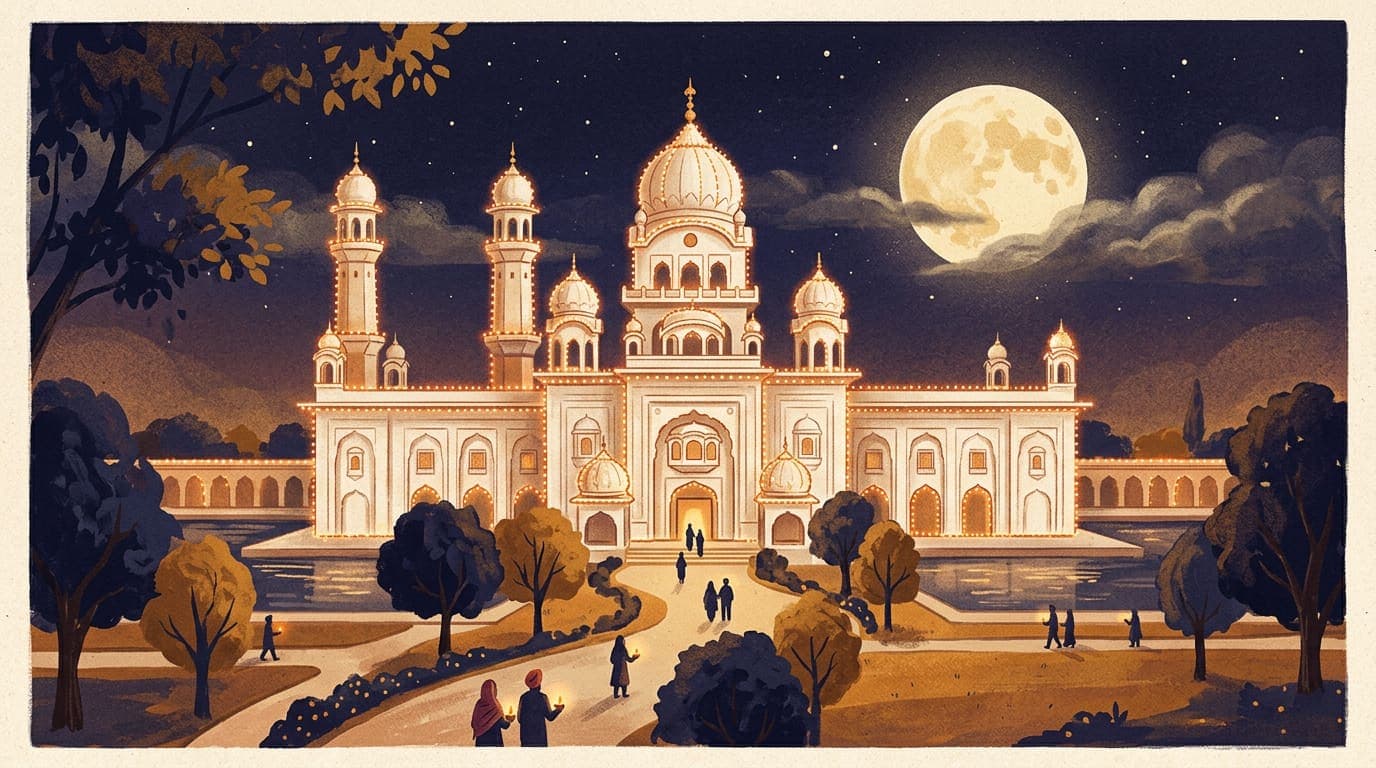
- Evening. The recitation of Rehras Sahib at dusk is followed by further kirtan. The gurdwara is illuminated, and in some places there are fireworks.
- Night. Many gurdwaras continue kirtan well into the night before the day closes with Kirtan Sohila and Sukhasan, when the scripture is respectfully closed.
The Nagar Kirtan procession usually takes place on one of the preceding days so that it does not clash with the main diwan.
Themes you will hear in the katha
Speakers at a Gurpurab tend to return to the same central ideas from Guru Nanak Dev Ji's hymns and life:
- One Creator, present in all. Sri Guru Granth Sahib Ji opens with Ik Onkar, the affirmation of One, in the Guru's own composition.
- Honest work and sharing. The ideals often summarised as kirat karni (earning by honest labour), naam japna (remembering the Divine) and vand chhakna (sharing with others).
- Equality. The rejection of caste hierarchy and the dignity of women, expressed in the practice of langar and in well-known passages of the Guru's hymns.
- Humility and service. The Kartarpur community, where the Guru himself worked the fields.
Our biography of Guru Nanak Dev Ji explores these teachings and their sources more fully.
Celebrating away from Punjab
For Sikhs in the diaspora, the Gurpurab often combines two days: the traditional date, marked by those who can attend, and a weekend programme when the whole sangat can gather. Nagar Kirtans in cities such as Birmingham, Toronto, Melbourne and New York have become major public events, often drawing people of every background. Schools and workplaces with Sikh members increasingly mark the day too, which makes it a natural moment to explain what the Gurpurab is about.
Summary
The Gurpurab of Guru Nanak Dev Ji is celebrated on Katak Puranmashi, a date established by long tradition even though early sources differ. It is anchored in places, Nankana Sahib, Sultanpur Lodhi and Kartarpur, and in the Guru's own words, sung from before dawn until late at night. Whether you mark it in Nankana Sahib or in a community hall far from Punjab, the day asks the same thing: to remember the light the Guru brought and to carry it forward in how we live.
Frequently asked questions
Was Guru Nanak Dev Ji born in April or November?
The sources differ. Several early janamsakhi traditions, including the Puratan and Meharban accounts, place the birth in Vaisakh (around April) 1469, while the Bhai Bala tradition gives the full moon of Katak. The Katak date became the established day of celebration and is observed at Sri Harmandir Sahib and most gurdwaras.
Which anniversary of Guru Nanak Dev Ji's birth is celebrated in 2026?
Counting from 1469, the Gurpurab in 2026 marks the 557th anniversary of Guru Nanak Dev Ji's birth. The 550th anniversary in 2019 was marked with major celebrations, including the opening of the Kartarpur Corridor.
Why is Guru Nanak's Gurpurab celebrated on a full moon?
Because it follows the traditional Bikrami reckoning, in which the day is fixed to the Puranmashi (full moon) of the month of Katak. Even the original 2003 Nanakshahi calendar, which fixed most Gurpurabs to solar dates, left this observance on the lunar date.