A Guide to Visiting Harmandir Sahib in Amritsar
What to wear, where to leave your shoes, how the darshan queue works, when to go for the quietest visit, and how to take part in langar and seva: a respectful, practical guide to visiting the Golden Temple.
Published Updated 6 min read

In this article
For many visitors, the first view of Sri Harmandir Sahib stays with them for life: stepping through the entrance, down onto cool marble, and seeing the gilded sanctum floating in the middle of the sarovar. Whether you are a Sikh pilgrim making a long-awaited journey or a traveller visiting Amritsar for the first time, a little preparation helps you feel at ease and show respect.
This guide covers the practical side of a visit. It deliberately does not list programme timings, which change with the seasons and on special days. The SGPC and the information office at the complex are the reliable sources for those.
Before you go
What to wear
- Cover your head. Everyone must cover their head within the complex. A scarf, bandana or turban is fine. Hats and caps are generally not considered appropriate. Orange scarves are available free at the entrances, and inexpensive ones are sold in the surrounding streets.
- Dress modestly. Choose clothing that covers your shoulders and legs. Loose, comfortable clothes work best, as you may sit on the floor.
- Wear shoes you can slip off easily. You will remove them before entering and walk barefoot throughout.
What not to bring
- Tobacco, alcohol and intoxicants are strictly prohibited in the complex.
- Large bags are best left at your accommodation or the luggage deposit.
- Selfie sticks and drones are not appropriate.
Getting there
Amritsar is served by Sri Guru Ram Dass Jee International Airport, a railway station with connections across north India, and interstate buses. The shrine is in the walled old city. The final approach is a pedestrian plaza, often called Heritage Street, leading to the main entrance by the clock tower. Cycle rickshaws, auto-rickshaws and app-based taxis will take you close. Some pilgrims arrive by the free shuttle buses that have run at times between the station and the complex; ask locally.
Arriving: shoes, feet and entrances
- Deposit your shoes. Free shoe stands (joda ghar) near each entrance are staffed by volunteers, many of whom see handling pilgrims' shoes as a meaningful act of seva. You will receive a token.
- Cover your head if you have not already.
- Wash your hands and feet. At each entrance you walk through a shallow channel of running water to wash your feet. There are also taps for washing your hands.
- Enter by stepping down. The complex lies below street level. This is traditionally explained as a reminder to approach with humility.
The main entrance is on the north side, beneath the clock tower, near the Central Sikh Museum. There are several other entrances around the complex.
Inside the complex
Walking the parikrama
The broad marble parikrama runs around the sarovar. Walk it clockwise, keeping the water on your right. Along the way you will pass several places of historic importance, including the Dukh Bhanjani Beri, a jujube tree associated with healing, and the Ber Baba Buddha Ji, where Baba Buddha Ji is remembered as having supervised the excavation of the sarovar.
The marble can become very hot in summer. Matting is usually laid along the main routes, and the parikrama is regularly washed by volunteers.
The darshan queue
To enter the sanctum, join the queue at the Darshani Deori, the ornate gateway at the head of the causeway. On busy days the wait can be long, sometimes several hours.
- Keep your place calmly, and expect the queue to move in stages.
- Inside the sanctum, the space is small and the sangat moves through quite quickly. Sevadars will guide you.
- Kirtan is sung continuously. Many visitors sit for a few minutes on the upper floors, where it is often less crowded.
- Photography is not allowed inside the sanctum.
Karah prashad
Karah prashad, a sweet offering made from flour, ghee, sugar and water, is distributed to everyone. You can also make an offering in exchange for a portion at the counters near the Darshani Deori. Receive it with both hands cupped together. It is respectful to eat it, not throw it away, so ask for a small amount if you prefer.
Bathing in the sarovar
Many Sikh pilgrims bathe in the sarovar. There are designated areas for men at the steps around the edge, and a covered area for women. Visitors do not have to bathe; many simply touch the water or sprinkle a little on their heads.
Langar: the Guru's kitchen
The Guru Ram Das Langar serves free, simple vegetarian meals to everyone, around the clock, and is often described as one of the largest community kitchens in the world. Joining the langar is one of the most memorable parts of a visit.
- Follow the crowd to the langar halls, where you will be handed a plate, bowl and spoon.
- Sit on the floor in rows (pangat). Everyone sits together as equals, which is the point of langar.
- Volunteers come along the rows serving dal, a vegetable dish, rotis and kheer or another sweet. Hold out your hands to receive rotis.
- Take only what you will eat. You can always ask for more.
- When you finish, hand your plate to the volunteers at the washing area as directed.
Seva: helping out
Anyone can take part in seva, selfless service. Visitors often help by:
- Peeling vegetables or rolling rotis in the langar kitchen.
- Washing dishes in the enormous washing area.
- Serving food or water in the langar hall.
- Helping at the shoe stands.
Just ask one of the sevadars where help is needed. Even half an hour of seva gives a real sense of how the complex runs.
When to visit
- For fewer crowds, choose a weekday, avoid public holidays and arrive early in the morning or late at night.
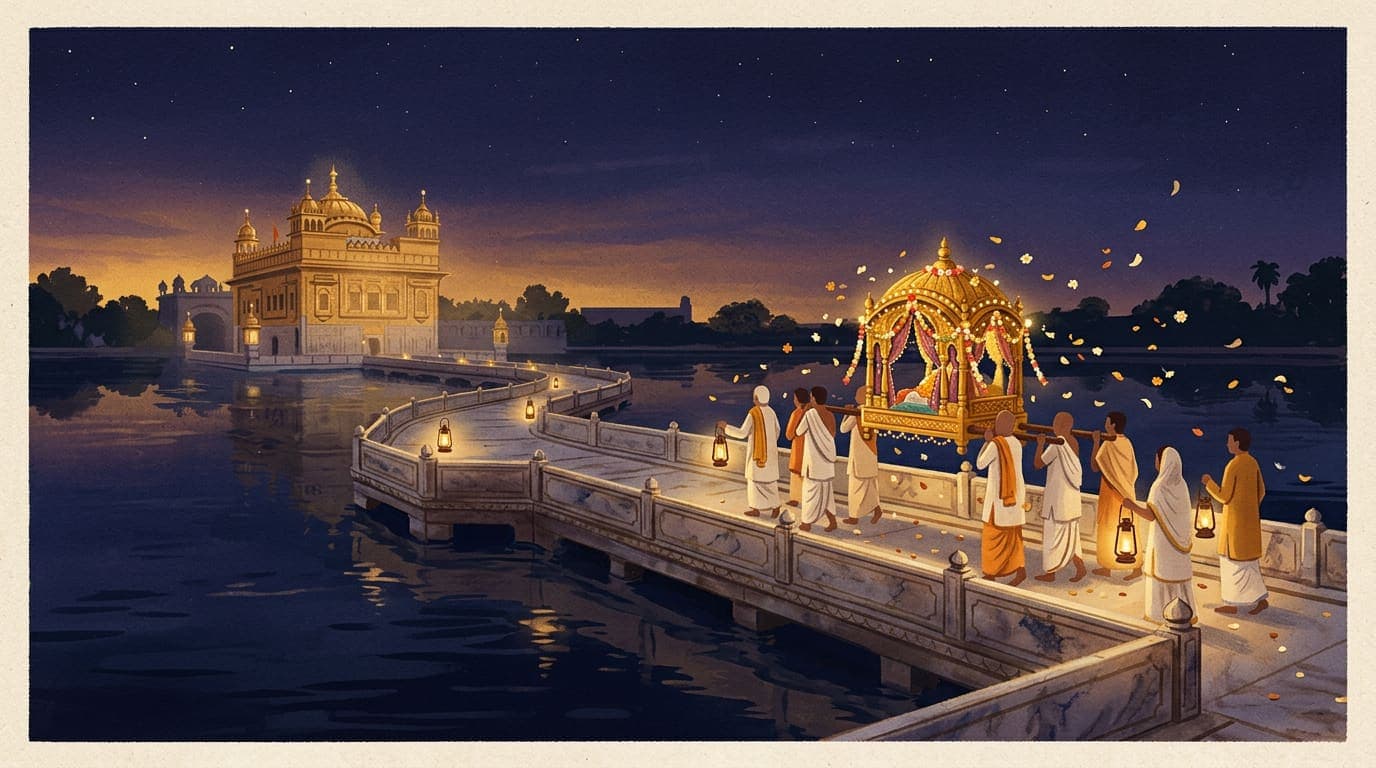
- For the atmosphere, the early-morning palki procession and Prakash, when Sri Guru Granth Sahib Ji is brought to the sanctum, and the night Sukhasan are deeply moving. Our article on the daily Hukamnama tradition explains the ceremony.
- At night, the illuminated shrine reflected in the sarovar is spectacular.
- On Gurpurabs and Bandi Chhor Divas, the complex is lit up and extraordinarily crowded. It is an unforgettable experience, but plan for very long queues.
- Season: winter (roughly November to February) is cool and pleasant, with foggy mornings. Summer (April to June) is extremely hot, making the marble hot to walk on at midday.
Photography and phones
- Photography is not allowed inside the sanctum. Rules for other areas can change, so follow signage and sevadars' instructions.
- Put your phone on silent, and avoid phone calls in the main areas.
- Be respectful when photographing people, especially those in prayer or bathing, and ask first.
- Avoid posing with your back to the sanctum or making gestures that could appear disrespectful.
Staying nearby
The SGPC runs several sarais (pilgrim guesthouses) close to the complex, offering basic accommodation. Availability varies, especially on festival days. There are also many private hotels and guesthouses in the old city and beyond.
Visiting with children or limited mobility
- Children are welcome. Keep them close in crowded areas and agree a meeting point in case you are separated.
- Wheelchair users and people with limited mobility can move around the parikrama, but crowds, steps and long queues can be challenging. Sevadars and the information office can advise on assistance.
Nearby places
- Jallianwala Bagh, a short walk from the main entrance, is the memorial to the massacre of 13 April 1919.
- The Partition Museum, in the Town Hall near the complex, tells the story of the 1947 Partition of Punjab.
- Gobindgarh Fort, a historic fort that has been restored and opened to visitors.
- The Attari–Wagah border, about 30 km away, where a daily flag-lowering ceremony takes place.
A short checklist
- Scarf or head covering.
- Modest clothes.
- Slip-on shoes.
- A small bag.
- Water in summer.
- Patience for queues.
- An open mind for langar and seva.
Summary
A visit to Sri Harmandir Sahib is free and open to everyone. Cover your head, dress modestly, leave your shoes at the joda ghar and wash your feet on entry. Walk the parikrama clockwise, queue at the Darshani Deori for darshan, receive karah prashad with cupped hands and share a meal in the langar. Check current timings and arrangements with the SGPC before you go. To understand what you are seeing, read our articles on the shrine's names and its history and architecture.
Frequently asked questions
Is there an entry fee for the Golden Temple?
No. Entry to Sri Harmandir Sahib is free for everyone, as are the langar meals and the shoe and luggage deposits run by volunteers.
Can non-Sikhs visit Harmandir Sahib?
Yes. People of every faith and background are welcome. The shrine's four entrances are traditionally explained as a sign that it is open to all. Visitors are asked to follow the same simple etiquette as Sikh pilgrims.
What should I wear to the Golden Temple?
Modest clothing that covers the shoulders and legs, and a head covering for everyone. Scarves are available at the entrances. Shoes and socks are removed before entering.
What are the Golden Temple's opening hours?
The complex is open around the clock, but the sanctum's programme, including the morning Prakash and the night Sukhasan, runs to times that vary by season and on special days. Check current timings with the SGPC or the information office at the complex.