Nanakshahi Calendar and Sikh Dates: A Practical Guide for Families and Communities
Why two calendars can give two different dates for the same Gurpurab, and what to do about it: a step-by-step method for confirming Sikh dates, plus practical advice for families, schools, workplaces and gurdwara committees.
Published Updated 6 min read
In this article
- Why dates differ: the short version
- What moves and what doesn't
- A real example: listings that disagree
- How to confirm a date: step by step
- Time zones and the diaspora
- For families
- For schools and employers
- For gurdwara committees and community organisers
- Using apps and digital calendars
- Sangrand, Puranmashi and Masya
- Summary
Every year, somewhere in a family group chat, the same question appears: "Is Gurpurab on the 14th or the 15th?" Someone shares a screenshot from one website, someone else shares a different date from another, and a grandparent remembers that it was on a Tuesday last year. If you have ever been confused about Sikh dates, you are not alone, and the confusion has a clear explanation.
This guide is practical. It explains briefly why dates differ, gives a step-by-step method for confirming a date, and offers advice for families, schools, employers and gurdwara committees. For the history behind it all, see our pillar article on the Nanakshahi calendar.
Why dates differ: the short version
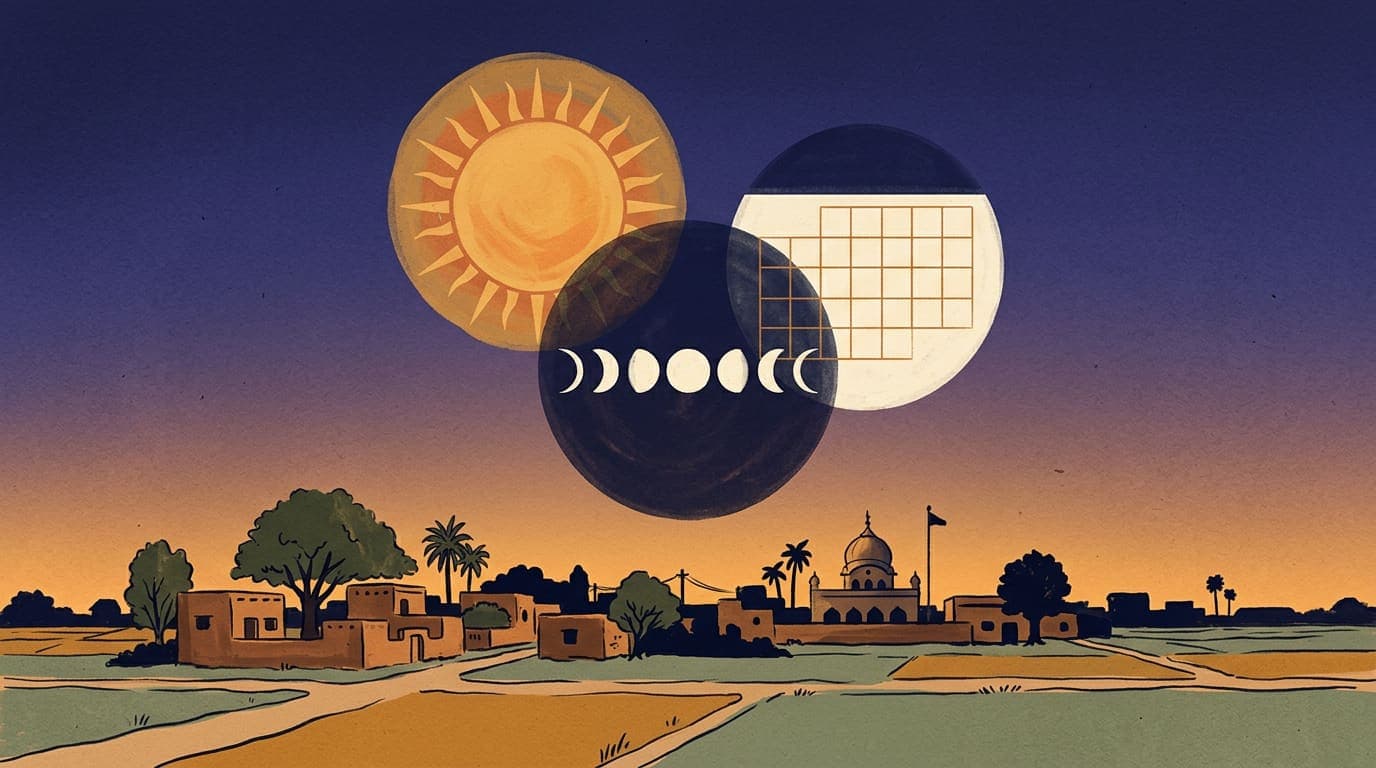
Three calendars shape Sikh dates:
- The Gregorian calendar, used for everyday life, school terms and work.
- The Bikrami calendar, the traditional calendar of north India. It has solar months, which begin on Sangrand, and lunar dates (tithis) set by the phases of the moon.
- The Nanakshahi calendar, a Sikh solar calendar adopted by the SGPC in 2003 that fixed many Gurpurabs on the same Gregorian date each year.
In 2010, the SGPC amended its calendar, returning Sangrand and several Gurpurabs to Bikrami dates. Some gurdwaras and organisations, especially in the diaspora, continue to follow the original version, now called the Mool Nanakshahi calendar. The result is that the same Gurpurab can fall on different dates depending on which calendar a gurdwara follows.
Our explainer on the Punjabi calendar goes into more detail about how the three calendars relate.
What moves and what doesn't
| Observance | SGPC calendar | Mool Nanakshahi calendar |
|---|---|---|
| Guru Nanak Gurpurab | Lunar (Kartik Puranmashi) | Lunar (Kartik Puranmashi) |
| Bandi Chhor Divas | Lunar (Kartik Amavas) | Lunar (Kartik Amavas) |
| Vaisakhi | Solar, 13 or 14 April | Fixed, 14 April |
| Prakash of Guru Gobind Singh Ji | Lunar, December or January | Fixed, 5 January |
| Martyrdom of Guru Arjan Dev Ji | Lunar, May or June | Fixed, 16 June |
| Martyrdom of Guru Tegh Bahadur Ji | Lunar, November or December | Fixed, 24 November |
| Sangrand | Bikrami solar dates | Fixed Gregorian dates |
Two observances, Guru Nanak Gurpurab and Bandi Chhor Divas, follow the lunar calendar in both systems, so they are the ones on which calendars are most likely to agree, apart from time-zone differences.
A real example: listings that disagree
At the time of writing, listings based on the SGPC calendar gave 8 November 2026 for Bandi Chhor Divas and 24 November 2026 for Guru Nanak Gurpurab, while some other online calendars showed different dates for some observances. If those SGPC-based dates are correct, Guru Nanak Gurpurab in 2026 falls on the same day that the Mool Nanakshahi calendar fixes for the martyrdom of Guru Tegh Bahadur Ji. Gurdwaras following that calendar would need to plan for both.
How to confirm a date: step by step
- Find out which calendar your gurdwara follows. Most gurdwaras in India follow the SGPC calendar. In the diaspora, practice varies. The gurdwara committee or the granthi will know.
- Check the primary source. For the SGPC calendar, use the annual jantri published by the SGPC, often displayed in gurdwaras and reproduced in local calendars. For Mool Nanakshahi, use the calendar issued by the organisations or gurdwaras that follow it.
- Check your gurdwara's programme. The gurdwara's own notice board, newsletter or social media page will show when the programme is being held locally.
- Note the difference between the date and the programme. A Gurpurab may fall on a Tuesday while the main diwan is held the following Sunday. Both are correct.
- Be wary of unsourced websites and forwarded images. If a listing doesn't say which calendar it follows, treat it with caution.
Time zones and the diaspora
Lunar dates depend on the moment of the full or new moon and on local sunrise. As a result, a lunar observance can fall on different Gregorian dates in different parts of the world. A tithi that begins late in the day in India may correspond to a different civil date in North America. Most diaspora gurdwaras simply follow the date announced in Punjab, or their own calendar, and hold programmes at the weekend. The important thing is to follow your own sangat's announcement.
For families
Keep a family calendar
At the start of each Nanakshahi year, in mid-March, when the SGPC calendar is usually released, add the main observances to your family calendar. Include:
- The major Gurpurabs and festivals your family marks. Our guide to Sikh Gurpurabs and festivals lists them season by season.
- Your gurdwara's own programme dates, which may be on weekends.
- Family anniversaries connected with the gurdwara, such as a child's naming ceremony or an Anand Karaj.
Planning family events
- Weddings and celebrations. Many families avoid holding weddings or parties during the weeks in late December when the martyrdom of the Sahibzade is remembered. Check with elders if you are unsure.
- Akhand Paths. If you plan to hold an Akhand Path at home or book one at the gurdwara around a Gurpurab, book early, as these periods are busy.
- Travel to Punjab. If you plan to be in Amritsar for Guru Nanak Gurpurab, Bandi Chhor Divas or Vaisakhi, book accommodation well in advance. See our guide to visiting Harmandir Sahib.
Explaining it to children
Children often notice that "Gurpurab moves". A simple explanation works well: "Some Sikh days follow the moon, so they move a little every year, like Eid or Easter. Others follow the sun, so they stay nearly the same." A printed gurdwara calendar on the wall is a good way to follow the year together.
For schools and employers
- Ask families rather than relying on a website. A short note home asking which dates matter to a Sikh family is more reliable than any online list.
- Expect some variation. Two Sikh families may observe the same Gurpurab on different dates, or both may observe the date while attending the gurdwara at the weekend.
- Plan for the main dates. The observances most likely to affect attendance or leave are Vaisakhi, Guru Nanak Gurpurab, Bandi Chhor Divas and Guru Gobind Singh Ji's Gurpurab.
- Use the correct names. For example, "Bandi Chhor Divas" alongside Diwali. Our short explainer Bandi Chhor Divas in English is written for exactly this purpose.
For gurdwara committees and community organisers
A little clarity goes a long way:
- State which calendar you follow on your annual calendar and website, for example "Dates follow the SGPC Nanakshahi calendar".
- Show both the date and the programme, for example "Gurpurab: Tuesday 24 November · Main diwan: Sunday 29 November".
- Publish early. Families plan leave and travel months in advance.
- Use a single source of truth. Keep one master calendar and update your website, notice board and social media from it.
- Mark changes clearly. If a date is corrected, say so, rather than silently changing it.
A simple format for a gurdwara calendar entry might look like this:
| Field | Example |
|---|---|
| Observance | Prakash Purab, Guru Gobind Singh Ji |
| Calendar date | As per the calendar you follow |
| Calendar basis | SGPC (lunar) or Mool Nanakshahi (fixed) |
| Local programme | Day, date and time of the main diwan |
| Notes | Akhand Path start and bhog times; Nagar Kirtan route; langar |
Using apps and digital calendars
Calendar apps and subscribable digital calendars are convenient, but check:
- Which calendar the app uses. Good apps say so.
- Who publishes it. A gurdwara or recognised Sikh organisation is more reliable than an anonymous listing.
- Whether it is updated. Lunar dates must be recalculated each year.
Sangrand, Puranmashi and Masya
Beyond the annual observances, many families like to mark monthly days:
- Sangrand, the first day of each solar month. Under the SGPC calendar these follow Bikrami dates, usually around the 13th to 16th of the Gregorian month. Under Mool Nanakshahi they fall on fixed dates. Our article on the Nanakshahi months lists the months.
- Puranmashi (full moon) and Masya (new moon), marked with programmes at many gurdwaras.
Summary
Sikh dates differ because the SGPC calendar places most Gurpurabs on lunar dates, while the Mool Nanakshahi calendar fixes several of them, and because lunar dates depend on location. The practical answer is simple: find out which calendar your gurdwara follows, check the primary source, distinguish the calendar date from the local programme and be cautious with unsourced listings. With a family calendar set up at the start of the Nanakshahi year, the question in the family group chat can be answered before anyone asks it.
Frequently asked questions
Why do different websites show different dates for the same Gurpurab?
Because more than one calendar is in use. The SGPC's current calendar places most Gurpurabs on lunar dates, while the Mool (original) Nanakshahi calendar fixes several of them on the same Gregorian date every year. Some websites also calculate lunar dates using different methods or time zones.
Which calendar should my family follow?
Most families follow the calendar used by their local gurdwara. In India this is usually the SGPC calendar. Some gurdwaras, especially in parts of the diaspora, follow the Mool Nanakshahi calendar. If in doubt, ask your gurdwara committee.
Why does my gurdwara celebrate on a Sunday instead of the actual date?
Many gurdwaras, especially outside India, hold the main congregational programme on the nearest weekend so that working families and children can attend. The observance itself is still associated with its calendar date.
Where can I find the official SGPC calendar?
The SGPC publishes an annual Nanakshahi calendar (jantri) listing Gurpurabs and other observances. It is usually released around the start of the Nanakshahi year in March and is available from the SGPC and widely reproduced by gurdwaras.