Punjabi Calendar Explained: Nanakshahi, Bikrami and Gregorian Calendars
Punjabi households live by three calendars at once. This explainer shows how the Bikrami, Nanakshahi and Gregorian systems work, why festival dates move, and how to read a Punjabi jantri.
Published Updated 6 min read
In this article
Pick up a calendar in a Punjabi home and you will often find three sets of dates on the same page. There is the Gregorian date that governs school and work, a Punjabi month name with its own day number, and small symbols marking the full moon, the new moon and the first day of the month. Each belongs to a different system, and together they explain why a festival can be "the same day as last year" and yet land on a different Gregorian date.
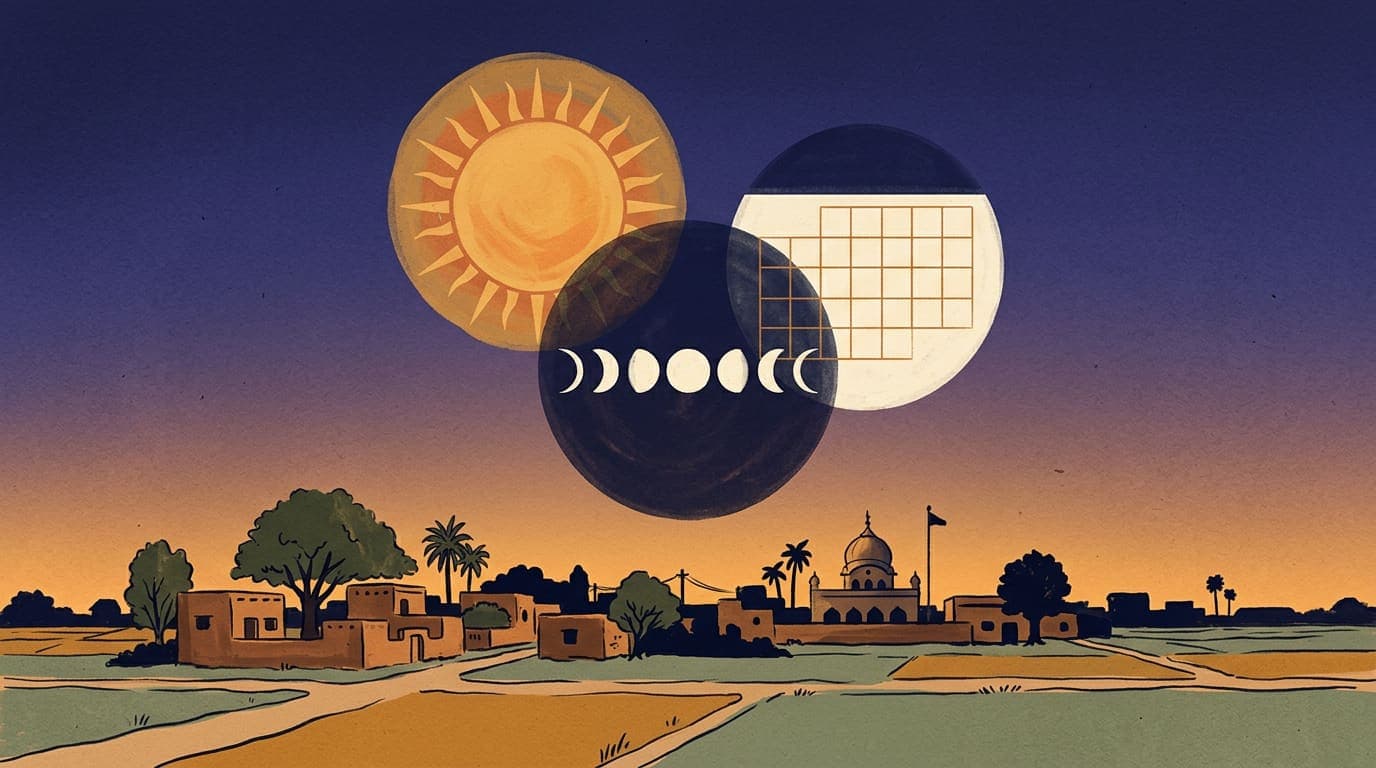
This article explains the three calendars that shape Punjabi and Sikh life, the Gregorian, the Bikrami and the Nanakshahi, and shows how they fit together.
One region, three calendars
"Punjabi calendar" is not a single, precisely defined system. In everyday speech it usually means the traditional Bikrami reckoning with Punjabi month names. For Sikh religious purposes, the Nanakshahi calendar was introduced in 2003 and remains in use in different versions. And for everything civil, from exam timetables to tax returns, Punjab uses the Gregorian calendar like the rest of the world.
None of these has entirely replaced the others. A farmer may speak of sowing "after Sangrand", a gurdwara notice may give a Nanakshahi date, and the same family will book a flight by the Gregorian date.
The Gregorian calendar
The Gregorian calendar is a solar calendar based on the tropical year, the time from one spring equinox to the next, about 365.2422 days. It uses a leap day every four years, skipping three leap days every four centuries, and so stays aligned with the seasons over the long term. It was introduced in Catholic Europe in 1582, adopted by Britain and its colonies in 1752, and came into official use in Punjab with British rule in the nineteenth century.
Its strength is stability: 14 April is always in spring. Its limitation, from a Sikh point of view, is that historical Sikh dates were never recorded in it.
The Bikrami calendar
The Bikrami calendar, also called Vikram Samvat, is the traditional calendar of much of northern India. Its era begins in 57 BCE, so Bikrami years run about 56 to 57 years ahead of Common Era years. It combines two kinds of month.
Solar months and Sangrand
Solar months begin when the sun enters a new sign of the zodiac. In Punjab, the first day of each solar month is called Sangrand (from the Sanskrit sankranti). Vaisakhi, for example, is traditionally the Sangrand of Vaisakh. Lohri falls on the last night of Poh and Maghi on the first day of Magh.
These solar months are reckoned against the fixed stars (a sidereal reckoning) rather than the equinoxes. The traditional year length used in these calculations is a little longer than the tropical year, so Sangrand dates drift later against the Gregorian calendar by roughly one day every six to seven decades. That is why Vaisakhi now usually falls on 13 or 14 April, whereas several centuries ago it fell some days earlier in Gregorian terms.
Lunar months, Puranmashi and Masya
Lunar months follow the moon. Each is divided into a bright half (sudi), as the moon waxes, and a dark half (vadi), as it wanes. In Punjab and much of north India a lunar month is conventionally counted as ending on the full moon, Puranmashi. The new moon is Masya (from amavasya).
A lunar year of twelve months is about eleven days shorter than a solar year. To stop the months drifting through the seasons, an extra lunar month, known as an intercalary or leap month (adhik maas), is inserted roughly every 32 to 33 months. This is why lunar observances slide earlier by about eleven days a year and then jump later by about a month.
Which Sikh observances use lunar dates
Many Gurpurabs are historically dated to lunar days. Guru Nanak Dev Ji's Gurpurab is observed on the Puranmashi of Katak, and Bandi Chhor Divas coincides with Diwali on the Masya of Katak. Both therefore move around within October and November.
The Nanakshahi calendar
The Nanakshahi calendar, designed by Pal Singh Purewal and adopted by the SGPC in 2003, is a tropical solar calendar like the Gregorian. Its year begins on 1 Chet (14 March), its era begins in 1469 (the year of Guru Nanak Dev Ji's birth), and its twelve months have fixed lengths and fixed Gregorian start dates. In its original form it gave most Gurpurabs permanent dates.
Since 2010, the SGPC has used an amended version that returns Sangrand and many observances to Bikrami reckoning, while many diaspora gurdwaras continue with the original. Our detailed guide to the Nanakshahi calendar's history and months covers this in full.
The three systems side by side
| Feature | Gregorian | Bikrami (traditional Punjabi) | Nanakshahi (original 2003) |
|---|---|---|---|
| Type | Solar | Lunisolar | Solar |
| Year basis | Tropical year | Sidereal solar year plus lunar months | Tropical year |
| Era begins | 1 CE | 57 BCE | 1469 CE |
| Year begins | 1 January | Chet (regional conventions vary) | 1 Chet = 14 March |
| Month starts | Fixed | Sangrand (solar) or after Puranmashi (lunar) | Fixed Gregorian dates |
| Leap mechanism | Leap day in February | Extra lunar month every 2–3 years | Extra day in Phagun |
| Festival dates | Fixed | Solar ones drift slowly; lunar ones move within a month | Mostly fixed |
| Typical use | Civil life worldwide | Traditional festivals, agriculture, many religious dates | Sikh observances (in versions) |
Why festival dates move
It helps to separate two kinds of movement.
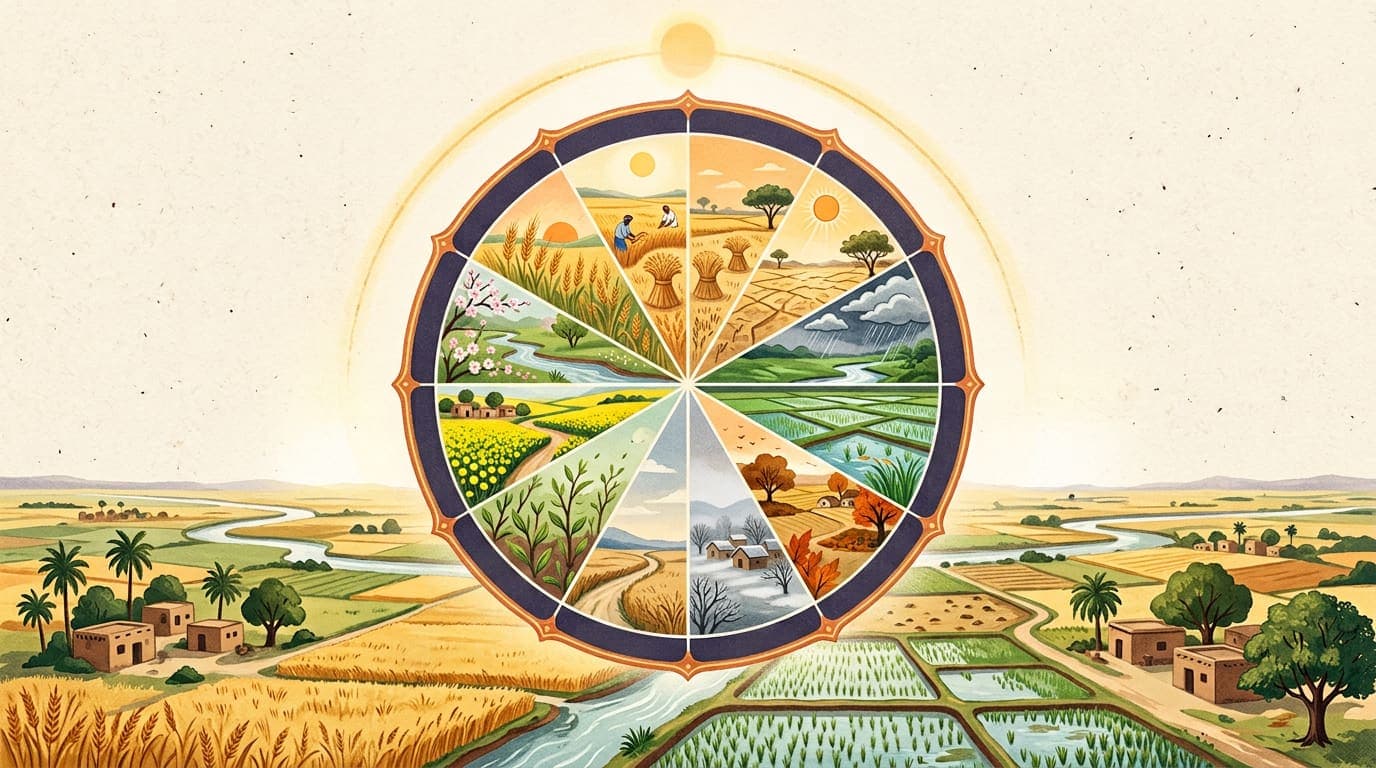
Slow drift. Solar Bikrami dates such as Vaisakhi, Lohri and Maghi move very little from year to year, usually falling on the same Gregorian date or the day either side. Over centuries they drift later.
Annual swing. Lunar dates such as Diwali, Guru Nanak's Gurpurab and Hola Mohalla move noticeably. A festival tied to the full moon of Katak can fall in late October one year and late November a couple of years later, depending on where the leap month falls.
The Nanakshahi calendar's original aim was to remove both kinds of movement for Sikh observances. Where an observance is still set by the lunar calendar, its date will continue to swing.
Month names across the systems
All three Punjabi systems share the month names Chet, Vaisakh, Jeth, Harh, Sawan, Bhadon, Assu, Katak, Maghar, Poh, Magh and Phagun. What differs is when each month begins:
- In the Nanakshahi calendar, Vaisakh always begins on 14 April.
- In the solar Bikrami calendar, Vaisakh begins on its Sangrand, usually 13 or 14 April.
- A lunar Vaisakh begins after the Puranmashi of Chet, which may be in late March or in April.
So when an elder says "in Vaisakh", they usually mean the season around April, and the exact start depends on the reckoning in use.
Reading a Punjabi jantri
A jantri is an annual almanac. A Sikh or Punjabi jantri typically shows:
- The Gregorian date and weekday.
- The Punjabi month and day, either Nanakshahi or Bikrami, and sometimes both.
- Sangrand, often highlighted, with the name of the new month.
- Puranmashi and Masya, usually with a full or dark moon symbol.
- Gurpurabs, martyrdom anniversaries and melas.
Before relying on a jantri, check the cover or introduction to see which calendar it follows. The SGPC publishes an annual calendar, and many gurdwaras and organisations abroad publish their own.
Which calendar should you follow?
For religious observances, the sensible starting point is the calendar used by your own gurdwara or sangat. If you are planning to be at Sri Harmandir Sahib for a Gurpurab, use the SGPC's published dates. If your local gurdwara follows the original Nanakshahi calendar, its programme may differ.
It is also worth remembering that many diaspora gurdwaras hold their main Gurpurab programme on the nearest weekend, whichever calendar they follow. For step-by-step planning, see our practical guide to Sikh dates for families and communities.
In summary
The Gregorian calendar keeps civil time, the Bikrami calendar carries centuries of Punjabi and Sikh tradition, and the Nanakshahi calendar was introduced to give Sikh observances stable dates of their own. Once you know which system a date comes from, the apparent contradictions on a Punjabi calendar page make sense. What looks like confusion is often three accurate answers to the same question, each from a different calendar.
Frequently asked questions
Is the Punjabi calendar lunar or solar?
The traditional Punjabi (Bikrami) calendar is lunisolar. It uses solar months that begin on Sangrand and lunar months that follow the moon, adding an extra lunar month roughly every two and a half to three years to keep the two in step. The Nanakshahi calendar is purely solar.
What is Sangrand?
Sangrand is the first day of a solar month in the Punjabi calendar, when the sun is reckoned to enter a new zodiac sign. Many gurdwaras hold a special programme on Sangrand and recite the matching verse of Barah Maha from Sri Guru Granth Sahib Ji.
What is the current Bikrami year?
The Bikrami era runs about 56 to 57 years ahead of the Common Era. Most of 2026 falls in Bikrami Samvat 2083. The exact changeover depends on the regional convention for the start of the year.
Why does Diwali or Guru Nanak's Gurpurab fall on a different date every year?
Both are fixed to lunar days in the Bikrami calendar: the new moon and full moon of the month of Katak. Lunar dates shift against the solar year by about eleven days each year until an extra month is inserted, so the Gregorian date moves within a window of roughly a month.